SPORTS MAGAZINE ADS
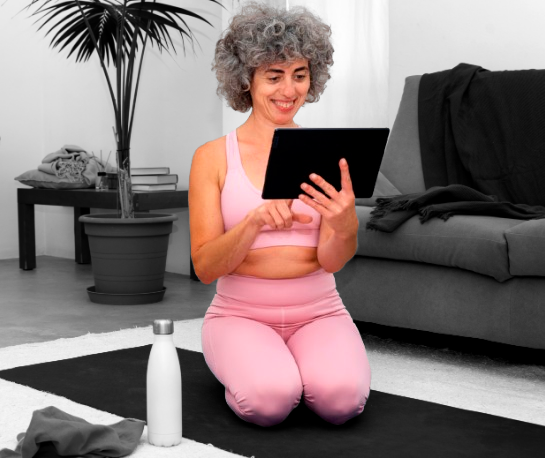
Um programa de exercícios domiciliares para idosos frágeis, baseado em aplicativo para tablet e monitoramento de mobilidade
Viabilidade e implicações práticas
|
OPEN ACCESS: Artigo disponível/Article available/Artículo disponible - ASSINANTE/SUBSCRIBER: Artigo para Assinante do periódico/Article for Journal Subscriber/Artículo para suscriptores de este periódico - PAY-PER-VIEW: Compre o artigo e leia/Buy the article and read/Compra el artículo y lee - IMAGE: https://www.freepik.com/author/freepik |
Palavras-chave:
Exercícios Domiciliares, Maturidade, Tecnologia, Idosos Frágeis, Monitoramento De MobilidadeResumo
O estímulo a um estilo de vida fisicamente ativo entre idosos é essencial para a saúde e o bem-estar. O objetivo deste estudo foi avaliar a viabilidade e a opinião dos usuários sobre um programa de exercícios domiciliares com o auxílio de um sensor e um aplicativo para tablet, destinado a idosos frágeis.
Referências
[1] Centraal Bureau voor de Statistiek. StatLine, Sociale monitor; 1990–2011. http://statline.cbs.nl/StatWeb/publication/?VW=T&DM=SLNL&PA=70115ned&D1=0,3-4&D2=a&D3=a&HD=081106-1151&HDR=T,G1&STB=G2. Dutch. Accessed March 9, 2015.
[2] US Department of Health and Human Services, Administration for Community Living. Administration on Aging: aging statistics. http://www.aoa.acl.gov/Aging_Statistics/index.aspx. Accessed February 12, 2014.
[3] King AC, Rejeski WJ, Buchner DM. Physical activity interventions targeting older adults. A critical review and recommendations. Am J Prev Med 1998;15[4]:316–33.
[4] Macera CA, Ham SA, Yore MM, Jones DA, Ainsworth BE, Kimsey CD, et al. Prevalence of physical activity in the United States: Behavioral Risk Factor Surveillance System, 2001. Prev Chronic Dis 2005;2[2]:A17.
[5] Schutzer KA, Graves BS. Barriers and motivations to exercise in older adults. Prev Med 2004;39[5]:1056–61.
[6] Eckert JK, Morgan LA, Swamy N. Preferences for receipt of care among community-dwelling adults. J Aging Soc Policy 2004;16[2]:49–65.
[7] Geraedts H, Zijlstra A, Bulstra SK, Stevens M, Zijlstra W. Effects of remote feedback in home-based physical activity interventions for older adults: a systematic review. Patient Educ Couns 2013;91[1]:14–24.
[8] Regterschot GR, Zhang W, Baldus H, Stevens M, Zijlstra W. Sensor-based monitoring of sit-to-stand performance is indicative of objective and self-reported aspects of functional status in older adults. Gait Posture 2015;41[4]:935–40.
[9] Regterschot GR, Folkersma M, Zhang W, Baldus H, Stevens M, Zijlstra W. Sensitivity of sensor-based sit-to-stand peak power to the effects of training leg strength, leg power and balance in older adults. Gait Posture 2014;39[1]:303–7.
[10] Regterschot GR, Zhang W, Baldus H, Stevens M, Zijlstra W. Test-retest reliability of sensor-based sit-to-stand measures in young and older adults. Gait Posture 2014;40[1]:220–4.
[11] Zhang W, Regterschot GR, Wahle F, Geraedts H, Baldus H, Zijlstra W. Chair rise transfer detection and analysis using a pendant sensor: an algorithm for fall risk assessment in older people. Conf Proc IEEE Eng Med Biol Soc 2014;2014:1830–4.
[12] Zhang W, Regterschot GR, Schaabova H, Baldus H, Zijlstra W. Test-retest reliability of a pendant-worn sensor device in measuring chair rise performance in older persons. Sensors (Basel) 2014;14[5]:8705–17.
[13] de Bruin ED, Hartmann A, Uebelhart D, Murer K, Zijlstra W. Wearable systems for monitoring mobility-related activities in older people: a systematic review. Clin Rehabil 2008;22(10-11):878–95.
[14] Geraedts HAE, Zijlstra W, Van Keeken HG, Zhang W, Stevens M. Validation and user evaluation of a sensor-based method for detecting mobility-related activities in older adults. PLoS One 2015;10[9]:e0137668.
[15] Harada ND, Dhanani S, Elrod M, Hahn T, Kleinman L, Fang M. Feasibility study of home telerehabilitation for physically inactive veterans. J Rehabil Res Dev 2010;47[5]:465–75.
[16] Wu G, Keyes L, Callas P, Ren X, Bookchin B. Comparison of telecommunication, community, and home-based Tai Chi exercise programs on compliance and effectiveness in elders at risk for falls. Arch Phys Med Rehabil 2010;91[6]:849–56.
[17] Weinstock RS, Brooks G, Palmas W, Morin PC, Teresi JA, Eimicke JP, et al. Lessened decline in physical activity and impairment of older adults with diabetes with telemedicine and pedometer use: results from the IDEATel study. Age Ageing 2011;40[1]:98–105.
[18] Silveira P, van de Langenberg R, van Het Reve E, Daniel F, Casati F, de Bruin ED. Tablet-based strength-balance training to motivate and improve adherence to exercise in independently living older people: a phase II preclinical exploratory trial. J Med Internet Res 2013;15[8]:e159.
[19] Pew Research Center. Tablet ownership 2013. http://www.pewinternet.org/2013/06/10/tablet-ownership-2013/. Accessed November 6, 2015.
[20] ANP Press Support. GfK: Evenveel Nederlanders met tablet als vaste computer. https://www.perssupport.nl/persbericht/88381/gfk-evenveel-nederlanders-met-tablet-als-vaste-computer. Accessed May 12, 2016.
[21] Jayroe TJ, Wolfram D. Internet searching, tablet use and older adults. Proceedings of the Association for Information Science and Technology. 2012 Oct 28–31; Baltimore, MD.
[22] Centraal Bureau voor de Statistiek. ICT gebruik van personen naar persoonskenmerken, 2005–2013. Dutch. http://statline.cbs.nl/StatWeb/publication/?VW=T&DM=SLNL&PA=71098ned&D1=33,55-59,93-95,97-100,102-104,106-109,112-113,119,124-133&D2=0&D3=0,l&HD=130422-1124&HDR=G2,G1&STB=T. Accessed January 29, 2014.
[23] Chang J, McAllister C, McCaslin R. Correlates of, and barriers to, Internet use among older adults. J Gerontol Soc Work 2015;58[1]:66–85.
[24] Zickuhr K, Madden M. Older adults and internet use. 2012. http://www.pewinternet.org/2012/06/06/older-adults-and-internet-use/.Accessed March 9, 2015.
[25] Bickmore TW, Silliman RA, Nelson K, Cheng DM, Winter M, Henault L, et al. A randomized controlled trial of an automated exercise coach for older adults. J Am Geriatr Soc 2013;61[10]:1676–83.
[26] Jimison HB, Klein KA, Marcoe JL. A socialization intervention in remote health coaching for older adults in the home. Conf Proc IEEE Eng Med Biol Soc 2013;2013:7025–8.
[27] Geraedts HA, Zijlstra W, Zhang W, Bulstra S, Stevens M. Adherence to and effectiveness of an individually tailored home-based exercise program for frail older adults, driven by mobility monitoring: design of a prospective cohort study. BMC Public Health 2014;14[1]:570.
[28] Steverink N, Slaets JPJ, Schuurmans H, Van Lis M. Measuring frailty: development and testing of the Groningen Frailty Indicator (GFI). Gerontologist 2001;41[1]:236–7.
[29] Spoorenberg SL, Uittenbroek RJ, Middel B, Kremer BP, Reijneveld SA, Wynia K. Embrace, a model for integrated elderly care: study protocol of a randomized controlled trial on the effectiveness regarding patient outcomes, service use, costs, and quality of care. BMC Geriatr 2013;13[1]:62.
[30] European Commission, Community Research and Development Information Service. Sensing and ACTION to support mobility in ambient assisted living. http://cordis.europa.eu/projects/rcn/80559_en.html. Accessed January 29, 2014.
_________________________________________
Article adapted for publication in accordance with the journal's submission rules, under the public domain license of the Preventing Chronic Disease Journal.
LEGAL NOTICE: The opinions expressed by the contributing authors to this article do not necessarily reflect the views of the U.S. Department of Health and Human Services, the Public Health Service, the Centers for Disease Control and Prevention, or the authors' affiliated institutions.